 Ever exchanged dollars for pounds before a trip to London? Or swapped euros for yen before landing in Tokyo? If so, you’ve already dipped a toe into the forex market without even realizing it. Forex, short for foreign exchange, is simply the trading of one currency for another. But on a global scale, it’s the largest financial market on the planet, with trillions of dollars moving among banks, businesses, governments, and everyday traders every day.For a beginner, all of this can sound overwhelming. Pips, leverage, margin calls, spread- it’s a lot of jargon thrown at you before you’ve even opened a trading account. Here’s the thing though: once you break it down piece by piece, forex trading really isn’t as complicated as it first seems. This guide covers what you actually need to know, from how the market functions to the practical steps for getting started, plus the risks nobody should skip over before putting real money on the table.
What Is Forex Trading, Really?
At its core, forex trading means buying one currency while selling another, with the hope of profiting from the shift in their relative value. Unlike stocks, where you’re buying a piece of a single company, currencies only ever trade in pairs. You can’t just “buy the dollar.” You buy the dollar against something else, say the euro or the yen.
Take EUR/USD as an example. If you think the euro is about to gain strength against the dollar, you’d buy that pair. Turns out you’re right, and the euro climbs? You close the trade for a profit. Wrong, and it falls instead? That’s a loss.
There’s no single building or exchange floor where forex trading happens, nothing like the New York Stock Exchange with its trading floor and opening bell. It’s all electronic, a sprawling network of banks and traders connected across time zones, running nearly nonstop, twenty-four hours a day, five days a week. That round-the-clock schedule is actually one of the biggest things that sets forex apart from stocks, where the market opens and shuts at fixed hours.
How the Market Actually Works
Major currency pairs quoted on a trading display
Before jumping in, it helps to know who’s actually on the other side of your trades and how the trading day unfolds.
Who’s trading
Central banks and governments trade currencies to keep their economies in check and manage exchange rates. Big commercial banks trade both for clients and for their own book. Multinational corporations swap currency constantly just to pay suppliers or employees abroad. And then there’s you, the retail trader, working through an online broker and hoping to catch a good move in price.
The trading sessions
Because this market spans the whole globe, trading unfolds across overlapping sessions centered on major financial hubs: Sydney, Tokyo, London, and New York. As one session winds down, another is just getting started somewhere else, which is why the market effectively never sleeps on weekdays. London and New York overlap for a few hours each day, and that window tends to see the heaviest volume and the sharpest price swings.
Currency pairs, explained
Every currency trade involves two currencies, listed as a pair. The first is called the base currency, the second is the quote currency. In GBP/USD, for instance, the pound is the base and the dollar is the quote. The number you see quoted tells you how much of the second currency it takes to buy one unit of the first.
Pairs generally fall into three buckets:
- Majors pair the US dollar with another heavily traded currency: think EUR/USD, GBP/USD, USD/JPY. These usually have the tightest spreads and the most liquidity, so they’re a natural starting point for beginners.
- Minors skip the dollar but still involve major currencies, like EUR/GBP or AUD/JPY.
- Exotics pair a major currency with one from a smaller or developing economy, such as USD/TRY or USD/ZAR. Expect wider spreads and rougher price swings here.
Terms You’ll Keep Running Into
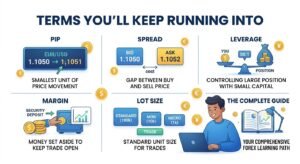
You don’t need to memorize a dictionary before your first trade, but a handful of terms show up constantly, so it’s worth getting familiar with them early.
Pip
This is the smallest standard unit of price movement for a currency pair. For most pairs, that’s the fourth decimal place, so EUR/USD moving from 1.1050 to 1.1051 is a one-pip move. Yen pairs work a little differently, where a pip usually sits at the second decimal place instead.
Spread
This is the gap between the buy price (ask) and the sell price (bid). It’s essentially the built-in cost of placing a trade, and it’s also how a lot of brokers make their money. A tighter spread means a cheaper trade, which matters a good deal if you’re trading often.
Leverage
Leverage lets you control a position much bigger than your actual account balance would normally allow on its own. With 50:1 leverage, for example, two thousand dollars could control a hundred-thousand-dollar position. Sounds great when it works in your favor. The catch is it magnifies losses the same way, so this is not something to treat casually.
Margin
Margin is the chunk of money your broker sets aside to keep a leveraged trade open, kind of like a security deposit. Let your balance drop too close to that requirement, and you risk a margin call, or worse, an automatic close of your position.
Lot size
A lot is just the standard trade size. A standard lot is 100,000 units of the base currency, a mini lot is 10,000, and a micro lot is 1,000. Most beginners stick to mini or micro lots at first, mainly to keep the risk manageable while they’re still learning the ropes.
Bid and ask
The bid is what buyers are offering to pay; the ask is what sellers want. That gap between them? That’s your spread again.
Getting Started: A Practical Walkthrough
Once the vocabulary starts to click, the next question is how to actually get going. Here’s a realistic path.
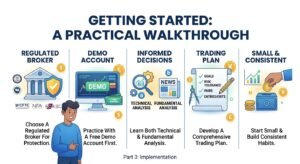
- Pick a broker that’s actually regulated: Your broker is where all the action happens, so this choice matters more than people realize. In the US, stick to brokers registered with the CFTC and the NFA. In the UK, look for FCA authorization. Regulated brokers have to keep client money separate from their own funds and follow fairly strict rules, which is a level of protection you simply don’t get with random offshore platforms promising huge leverage and no restrictions.
- Start on a demo account: Nearly every decent broker offers a free demo account loaded with fake money. Use it. This is honestly one of the smartest ways to get comfortable with the platform, understand how orders actually execute, and practice reading charts, all without risking a dollar of your own.
- Learn how traders actually make decisions: Good trading isn’t guesswork, or at least it shouldn’t be. There are two main schools of thought here, covered just below, and it’s worth understanding both before real money is involved.
- Put together an actual plan: A trading plan lays out your goals, how much you’re willing to risk on any given trade, which pairs you’ll focus on, and the conditions that would make you enter or exit a position. Skip this step, and you’ll likely end up trading off gut feeling, which tends not to end well.
- Start small, stay consistent: When you finally go live, trade with an amount you can genuinely afford to lose. Forex rewards patience far more than it rewards big swings for quick money, especially early on.
Technical vs Fundamental: The Two Main Approaches
Most experienced traders lean on a blend of two core methods.
Technical analysis
This is about reading price charts and patterns to guess where price might go next. Traders lean on tools like moving averages, support and resistance zones, and indicators such as the RSI to time their entries and exits. The underlying idea is that price behavior tends to repeat itself, largely because trader psychology doesn’t change much over time.
Fundamental analysis
This side looks at the economic forces behind currency values, things like interest rate decisions, inflation data, jobs reports, and geopolitical events. When a central bank hikes rates, for instance, that currency often strengthens because higher rates tend to pull in foreign investment. Keeping an eye on the economic calendar is a big part of this approach.
Sentiment
There’s also a looser, third approach: gauging whether the market as a whole feels bullish or bearish on a currency. Most traders fold this into their technical or fundamental analysis rather than relying on it alone.
Risk Management Is Where Most Beginners Fail
If there’s one skill that separates traders who stick around from those who blow up their account in a month, it’s risk management. A few principles worth internalizing:
- Use stop loss and take profit orders. A stop loss shuts your trade automatically once price moves against you by a set amount. A take profit does the opposite, locking in gains once your target is hit. Both take the emotion out of the equation, which matters more than most beginners expect.
- Don’t oversize your positions. A common rule among experienced traders is to risk no more than one or two percent of the account on a single trade. That way, a rough stretch of losses doesn’t wipe you out completely, and you’ve still got room to learn and adjust.
- Respect what leverage can do. It cuts both ways. A relatively small move against you can wipe out a large chunk of a heavily leveraged position fast. Beginners are usually better off keeping leverage low until they’ve really felt how it behaves in practice, not just read about it.
- Watch the emotional side. Fear and greed wreck more accounts than bad strategy does. Doubling down after a loss, or bailing on a winning trade too early out of nerves, both tend to hurt you over time. Sticking with your plan, even when it feels uncomfortable in the moment, is genuinely one of the harder skills to build.
A few mistakes worth avoiding altogether: trading with no real plan, risking too much on one position, ignoring major economic news, overusing leverage without really grasping it, and letting emotion drive decisions instead of your own analysis.
The Upside and the Downside
What’s appealing about it
The market runs nearly around the clock, so it fits around almost any schedule. Liquidity tends to be high, meaning trades usually fill close to the price you expect. Leverage means you can start with a relatively modest amount of capital. And there’s no shortage of pairs to trade if you want variety.
What to watch out for
Volatility cuts both ways, so losses can pile up just as fast as gains. Leverage, while useful, raises the stakes considerably if it’s not handled with care. There’s a real learning curve if you’re new to financial markets in general. And success here demands ongoing discipline and emotional control, which, honestly, isn’t for everyone.
Is Any of This Even Legal?
Yes, forex trading is fully legal in both the US and the UK, though it’s closely regulated in both places to keep retail traders somewhat protected from fraud and reckless risk-taking.
In the United States, brokers have to register with the CFTC and belong to the NFA. US rules also cap leverage at 50:1 on major pairs and block certain practices, like hedging within a single account, that are allowed elsewhere in the world.
In the UK, the Financial Conduct Authority handles oversight of forex and CFD brokers, enforcing rules on capital requirements, keeping client funds separate, and requiring transparent pricing. The FCA has a solid reputation globally as one of the more trustworthy regulators out there.
Wherever you’re trading from, always double-check that your broker is properly licensed before you deposit a single dollar or pound. Regulation won’t guarantee you’ll make money, but it does offer real protection against fraud and mismanaged funds.
Wrapping Up
Forex trading can offer real opportunity, but let’s be honest, it’s not a shortcut to getting rich fast. The traders who actually stick around and do well long-term are the ones who take the time to understand how the market moves, practice heavily on a demo account first, manage their risk seriously, and treat this as a skill built over months and years, not days. If you’re just getting started, put education first. Learn the terms, understand how leverage and margin interact, and build a real trading plan before you ever put actual money on the line. The market isn’t going anywhere. It’ll still be there once you are.
Frequently Asked Questions
Is forex trading profitable for beginners?
It can be, though most beginners actually lose money in their first few months. Profitability tends to come with time, discipline, and a genuine grasp of risk management, not from a lucky early trade or two.
How much money do I need to start forex trading?
Some brokers let you open an account with as little as a hundred dollars. Starting with more gives you more flexibility with position sizing, but the real rule is simple: only trade money you can afford to lose completely.
Can I trade forex part time?
Yes, absolutely. Since the market runs twenty-four hours a day on weekdays, plenty of traders fit it around a full-time job, focusing on whichever session lines up with their schedule.
Is forex trading gambling?
Not really, not if you’re trading with analysis, a clear strategy, and actual risk management in place. That said, trading purely on gut feeling with no plan starts looking a lot like gambling pretty quickly.
